Stop Guessing. Fish the Conditions.
Enter today's water, weather, and season — get a complete fishing strategy: the highest-confidence lure, color, retrieve, bass behavior read, and a backup pattern.
Tell us today's conditions
Five quick taps. Everything is pre-filled — change only what you know.
Where the bass are in their yearly cycle.
Surface water temp — not the air temperature.
How far down you can see your bait.
What the weather has been doing the last day or two.
When you'll actually be on the water.
Anglers who catch fish work backwards
Most anglers pick a lure first and hope it matches the day. The consistent ones start with what the water, weather, and fish are doing — then let the conditions choose the lure.
Water temperature, clarity, wind, forage, seasonal patterns, and bass behavior all change the answer. A cold front, a wind shift, or a shad migration rewrites the game plan.
LureLogic reads those inputs and returns a decision instead of a guess.
How LureLogic Builds Today's Fishing Strategy
Every fishing strategy is built using condition-based decision logic that evaluates today's water, weather, season, bass behavior, and forage before identifying the highest-probability approach.
A complete game plan in seconds
Season, water clarity, temperature, weather, and time of day.
The engine explains how bass positioning and feeding shift with today's inputs.
Lure, color, depth, cover, retrieve cadence, and a backup pattern — ready to fish.
Best Bass Lure Buying Guides
Editor-tested picks and recommended colors for the lure categories bass anglers throw most. Every guide includes a proven three-product short list.
Learn Bass Fishing Patterns
The four frameworks behind every recommendation. Each pillar bundles the supporting articles for that topic into one place.
Understanding Bass Fishing Conditions
Bass fishing success often depends on understanding how environmental conditions influence fish behavior. Water temperature, clarity, weather patterns, seasonal transitions, forage activity, and fishing pressure all affect which lures bass are most likely to respond to.
LureLogic helps simplify these decisions by using condition-based fishing logic to recommend high-confidence lure categories and presentations for changing bass fishing conditions.
Water Temperature and Bass Behavior
Water temperature is the single most influential factor in bass behavior. Bass are cold-blooded, so their metabolism — and by extension their feeding aggression, chase distance, and depth preference — tracks the temperature of the water around them. In cold water below 50°F, metabolism slows dramatically. Feeding windows shrink, fish stack on the deepest available structure, and slow, deliberate presentations like a winter jerkbait or blade bait stay in the strike zone long enough to draw a bite.
As water warms through the 50s, bass begin to move shallower in staging waves. The 55°F threshold is one of the most exciting times of year — pre-spawn bass push toward spawning flats and chase moving baits like chatterbaits and lipless crankbaits between feeding windows. Warming trends matter even more than the absolute number: two consecutive sunny afternoons in early spring will activate fish more than a single warmer day after a cold snap.
In summer water above 75°F, reaction baits work best at low-light edges of the day, while bass slide deep into cooler structure during the midday sun. Knowing whether to throw reaction or finesse comes down to reading the temperature trend, not just the temperature itself.
Water Clarity and Lure Selection
Water clarity changes how bass detect prey. In clear water, bass feed primarily by sight — they inspect a bait before committing, which means realistic profiles, natural colors, and smaller finesse presentations consistently outproduce loud, flashy baits. Clear-water fishing rewards patience and downsizing.
In stained water, bass still use vision but rely more heavily on the lateral line. Mid-range vibration baits — bladed jigs, willow/Colorado spinnerbaits, and squarebill crankbaits — work because they give the fish a sensory target from a longer distance. Color selection becomes a balance: natural enough to look like forage, bold enough to stand out.
In muddy water, visibility can drop to inches. Bass switch almost entirely to lateral-line feeding. Profile and vibration dominate — chatterbaits, big-bladed Colorado spinnerbaits, and dark-colored jigs with rattles outperform realistic finishes. Don't downsize: bass need to detect the bait before they can commit.
Seasonal Bass Fishing Patterns
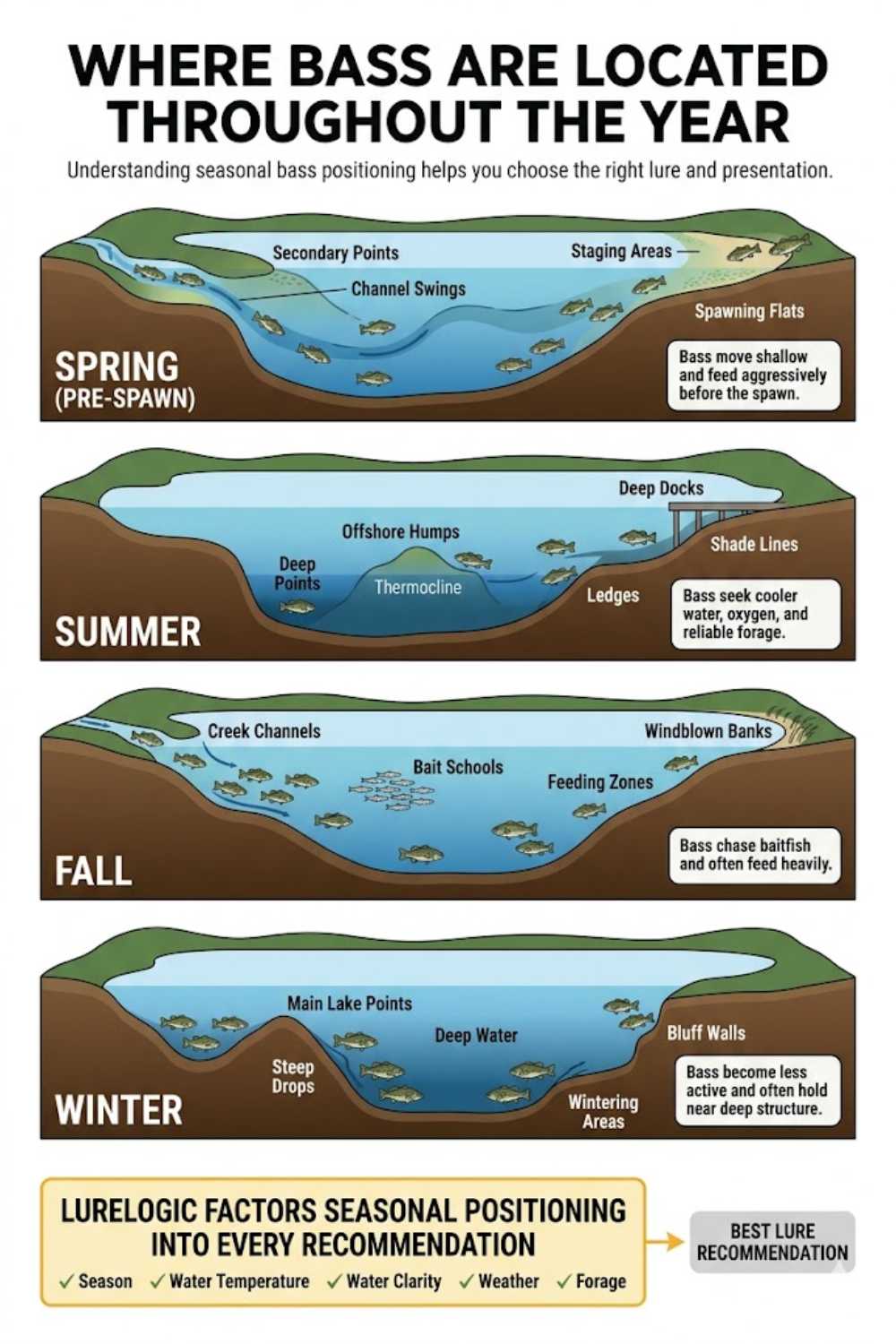
Pre-spawn bass (typically late winter through early spring) stage on secondary points, channel swings, and the first deep break leading into spawning flats. Moving baits and a suspending jerkbait are the dominant tools — see our pre-spawn lure guide for the full breakdown.
Spawn brings bass shallow onto hard-bottom pockets and isolated cover, often timed with the bluegill spawn. Sight fishing with soft plastics, creature baits, and small jigs produces territorial strikes. Bites are often reaction-based rather than feeding-based.
Post-spawn bass recover slowly. Many fish suspend near deep cover before transitioning to summer patterns. Our post-spawn guide covers the slow-down period that frustrates so many anglers.
Summer splits the population — deep main-lake structure during sun, shallow ambush spots at first/last light. Summer topwater is one of the most exciting bites of the year.
Fall transition has bass following the shad migration into the backs of creeks. The fall pattern is essentially "find the shad, find the bass."
Winter concentrates bass on the deepest available structure. Long pauses, vertical presentations, and patience define the winter bite.
Weather Conditions and Feeding Activity
Cloud cover extends the reaction-bait window through the middle of the day by reducing the sun penalty that pushes bass tight to cover. On overcast days, bass roam more aggressively and chase further — bring more moving baits.
Wind is one of the most underrated bass-fishing variables. It stacks bait on the windblown bank, oxygenates the water, and breaks up the surface so bass feel less exposed. Most days, the windiest bank on the lake is the most productive.
Cold fronts are the most challenging weather pattern to fish. High pressure and a drop in air temperature tighten bass to cover and shut down chase behavior. Slow down, shorten your casting lanes, and lean on finesse — our post-cold-front guide covers the specific presentations that still produce.
Falling barometric pressure ahead of a storm often triggers an aggressive feeding window, while rising pressure behind a front signals a slowdown. Rain itself often improves the bite by reducing light and adding shoreline runoff that pulls bait shallow.
Where Bass Are Located Throughout the Year
Finding bass is often more important than selecting the perfect lure. Seasonal movements influence where bass position, how they feed, and which presentations become most effective.
Understanding these seasonal patterns can dramatically shorten the learning curve.
Learn More About Seasonal Bass Behavior
Get Monthly Bass Fishing Intel
Seasonal bass patterns, water temperature trends, lure recommendations, and high-confidence bait ideas delivered monthly.
Fishing Guides
Deep dives on seasonal patterns, water clarity, and high-confidence lure selection.